



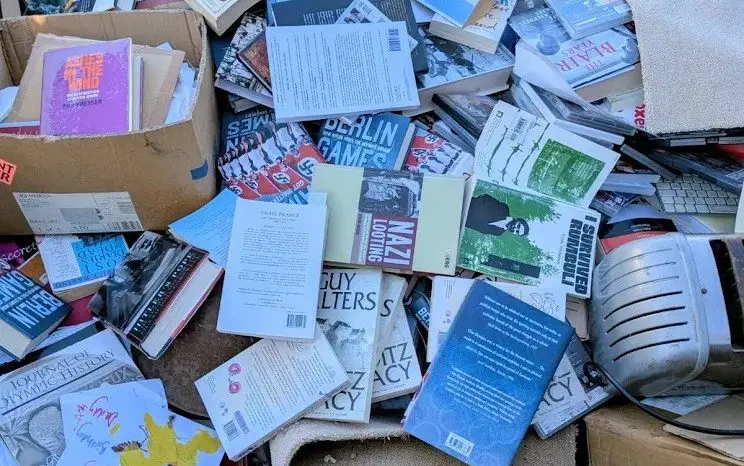
There are few sights more calculated to make an author question his career than chucking hundreds of books into a skip. Over the past week, I estimate I have thrown away about 1,500 of them. Even typing that feels dreadful.
Aren’t books supposed to be the things you rescue from skips? You spot a spine with a familiar name, lean over, and congratulate yourself on saving civilisation. This time, I was the barbarian putting them in.
As well as throwing away books by writers both great and small, there too in the skip were my own books, dumped among the tangled old cables and general clutter of moving house. At least, nobody can accuse me of applying different standards to other writers. I was tasting my own medicine, several copies at a time.
It went against every grain in my body. I know the work that goes into them – the research, the checking, the years spent trying to understand what happened and why. Watching the results join the rubbish felt like a personal betrayal. It is hard to shake the feeling that throwing away a book means throwing away some small part of your mind.
Let me explain why I did it. First, I just don’t have the space, and secondly, I simply don’t need many of them. So how to get rid? I tried libraries and archives. They did not want them. A militaria bookseller said I would have to pay him to take them away. Here was an exciting development in the literary economy – the author paying twice, first to acquire knowledge, then to have it removed.
A charity shop cannot simply absorb 1,500 books because their owner feels guilty. Nor can you stuff them into one of those village telephone boxes converted into little libraries. There is a difference between leaving a Lee Child for a neighbour and unloading a pallet of 20th-century warfare.
Yes, I could have sold them individually on Amazon or the like. I could also have spent the next several years wrapping parcels and trudging to the post office. But surely there comes a point when recovering a small amount of dosh comes with an opportunity cost, as there are surely more worthy ways to spend one’s time.
The trouble with, say, history hardbacks is that their virtues as books bear little relation to their value as merchandise. Antony Beevor’s Stalingrad remains a superb work. Its enormous popularity hardly makes an ordinary second-hand copy scarce, and so a copy is worthless.
But obscurity is no guarantee of value either. In the past, I’ve listed obscure books on Amazon for many, many years, and not a nibble.
Then there are all the other private libraries being dismantled. The generations who filled houses with books are downsizing or dying. Their children are now inheriting the shelving problem. Our cherished libraries simply cannot all become somebody else’s cherished libraries.
And the practical case for keeping them has weakened. Much of the information I once needed a wall of books to consult is available online. That does not make every website trustworthy, or every old book redundant. It does make keeping everything for some hypothetical future requirement rather difficult to justify.
Most of us have accepted that enjoying a film need not involve owning its plastic box. Of course, books provoke stronger feelings than DVDs, but a hardback has to earn its space.
The majority of the books I chucked had not been opened in 20 years. Twenty years! In truth, I was hoarding, and was preserving the possibility that a future version of me might suddenly require them.
There comes a time in your life – I’m 55 – when you realise that you pretty much are the future version of yourself, and if you haven’t looked at something since you were 35, you aren’t going to look at it when you’re 75.
Paying to store them would merely have added an unnecessary monthly bill. Besides, if I need a title again, I can look online or buy another secondhand copy. The abundance that makes selling so depressing makes replacing surprisingly easy.
But along with the guilt, what I had not anticipated was the relief. I now feel purged. The sadness is real, but so is the pleasure of no longer being responsible for a skip-load of printed wood. I can remember what those books gave me without retaining their physicality.
The Swedes call clearing out your possessions before your relatives have to do it döstädning: death cleaning. I hope to remain alive for a good while yet, but there is satisfaction in getting ahead of the game. Whoever eventually clears up after me will have enough to contend with.
And if they want a copy of one of my books, I trust they will buy it. That, or look in a skip.